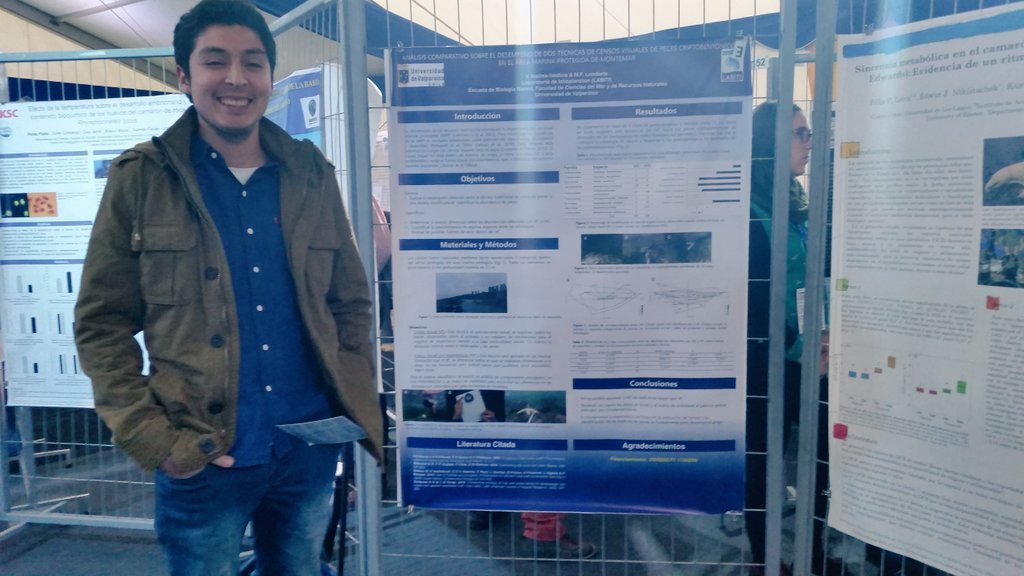
Entre el 23 y 27 de Mayo se realizó el Congreso de Ciencias del Mar, organizado por la Universidad de Concepción, Concepción, Chile. En esta oportunidad, dos miembros del Laboratorio de Ictioplancton (LABITI) presentaron sus resultados. El estudiante de Biología Marina, Victor Molina-Valdivia, presentó un panel titulado "Análisis comparativo de dos técnicas de censos visuales de peces criptobentónicos en el Área Marina Protegida de Montemar", correspondiente a los resultados de su Seminario de Investigación.
Por otro lado, la biólogo marino Macarena Díaz-Astudillo expuso un avance de los resultados del proyecto Fondecyt 1150296, titulado "¿Afectan los ciclos lunares a los ensambles ictioplanctónicos? Un caso de estudio en peces costeros de Chile central" en la sesión de Ictiología del Congreso.
¡Felicitaciones a ambos por sus trabajos!
domingo, 29 de mayo de 2016
jueves, 5 de mayo de 2016
LABITI visita el ISMAR, en Ancona, Italia / LABITI visits ISMAR, in Ancona, Italy
El Dr. Mauricio F. Landaeta se encuentra realizando una visita al laboratorio del Dr. Mario La Mesa, de CNR-ISMAR, Istituto di Scienze Marine, ubicado en Ancona, Italia.
Dr. Mauricio F. Landaeta is now visiting the lab of Dr. Mario La Mesa at CNR-ISMAR, Istituto di Scienze Marine, located at Ancona, Italy.
La colaboración ha surgido a través del proyecto INACH RT_04-13, sobre ecología de larvas de peces Antárticos, específicamente en Isla Greenwich, Islas Shetland del Sur, dentro del cual el Dr. La Mesa está cooperando con el análisis de la microestructura de otolitos sagitta del pez Harpagifer antarcticus (Notothenioidei: Harpagiferidae).
Colaboration between both scientists has been initiated through Project INACH RT_04-13, about larval fish ecology from Antarctica, specifically from Greenwich Island, South Shetland Islands. Specifically, Dr. Mario La Mesa is cooperating with the otolith microstructure analysis of sagittae otoliths from plunderfish Harpagifer antarcticus (Notothenioidei: Harpagiferidae).
El laboratorio del Dr. La Mesa en ISMAR está completamente equipado para realizar estudios de microestructura de otolitos, tanto de larvas como de juveniles y peces adultos.
Dr. La Mesa lab, at ISMAR, is fully equipped for the study of otolith microstructure, as for larvae as for juvenile and adult fish.
Este proyecto antártico corresponde a la primera cooperación entre ISMAR y una institución chilena, Universidad de Valparaíso (número 9 en la foto).
This Antarctic Project is the first cooperation between ISMAR and a Chilean institution, Universidad de Valparaíso (number 9 in the picture).
Dr. Mauricio F. Landaeta is now visiting the lab of Dr. Mario La Mesa at CNR-ISMAR, Istituto di Scienze Marine, located at Ancona, Italy.
La colaboración ha surgido a través del proyecto INACH RT_04-13, sobre ecología de larvas de peces Antárticos, específicamente en Isla Greenwich, Islas Shetland del Sur, dentro del cual el Dr. La Mesa está cooperando con el análisis de la microestructura de otolitos sagitta del pez Harpagifer antarcticus (Notothenioidei: Harpagiferidae).
Colaboration between both scientists has been initiated through Project INACH RT_04-13, about larval fish ecology from Antarctica, specifically from Greenwich Island, South Shetland Islands. Specifically, Dr. Mario La Mesa is cooperating with the otolith microstructure analysis of sagittae otoliths from plunderfish Harpagifer antarcticus (Notothenioidei: Harpagiferidae).
El laboratorio del Dr. La Mesa en ISMAR está completamente equipado para realizar estudios de microestructura de otolitos, tanto de larvas como de juveniles y peces adultos.
Dr. La Mesa lab, at ISMAR, is fully equipped for the study of otolith microstructure, as for larvae as for juvenile and adult fish.
Este proyecto antártico corresponde a la primera cooperación entre ISMAR y una institución chilena, Universidad de Valparaíso (número 9 en la foto).
This Antarctic Project is the first cooperation between ISMAR and a Chilean institution, Universidad de Valparaíso (number 9 in the picture).
miércoles, 4 de mayo de 2016
Otolitos de larvas de Bathylagichthys parini (Bathylagidae) / Otoliths of larval Bathylagichthys parini (Bathylagidae)
Dentro del contexto del proyecto CIMAR 20 14-09, Gissella Castillo-Hidalgo comenzó la extracción y montaje de otolitos sagitta de las larvas del pez batilágido Bathylagichthys parini. Se seleccionó esta especie (junto con la merluza austral Merluccius australis) debido a su amplia distribución en el mar interior de la Patagonia austral de Chile, y para determinar si las condiciones ambientales, particularmente la pluma de baja salinidad y alta turbidez causada por los aportes orgánicos de los ríos Pascua y Baker generan diferencias en el crecimiento reciente y asimetría de sus otolitos. A continuación se presentan fotografías del trabajo de Gissella.
In the context of the Project CIMAR 20 14-09, Gissella Castillo-Hidalgo started the extraction and mounting of sagittae otoliths of larval Bathylagichthys parini (Bathylagidae). This species, together with larval southern hake Merluccius australis, were selected because of their large abundance in the inner seas of Chilean Patagonia. We want to establish if the environmental conditions, dominated by the effect of the river's plume of low salinity and high turbidity caused by the high amount of organic debris from rivers Pascua and Baker may trigger differences in recent growth (microincrement widths) and asymmetry of left and right otoliths. Here we can see some pictures of the larvae and their otoliths captured by Gissella.
jueves, 28 de abril de 2016
Taller de tinción de larvas de peces - Workshop about larval fish staining
Durante las pasadas semanas, Francisca Zavala-Muñoz dictó a los miembros del LABITI un taller de tinción de larvas de peces con alizarina roja (huesos) y alcian blue (cartílagos). Se usaron como material de ensayo larvas de peces de dos grupos muy diferentes, un Syngnatiformes, el pez aguja Leptonotus blainvilleanus, y un Ophidiiformes, la brótula Cataetyx messieri, ambos recolectados en aguas interiores de la Patagonia austral.
During the past weeks, Francisca Zavala-Muñoz make a workshop for the members of LABITI about staining methods for fish larvae, with alizarin red (bones) and alcian blue (cartilages). As biological materials, we used two species with great morphological differences, a Syngnatiformes, Leptonotus blainvilleanus, and a Ophidiiformes, brotula Cataetyx messieri, both collected in sea waters from inner seas of Chilean Patagonia.
Leptonotus blainvilleanus
Muchas gracias Fran por tu tiempo y las clases! / Thank you very much Fran for your time and support!
miércoles, 27 de abril de 2016
Nuevas identificaciones de presas del góbido Kelloggella disalvoi de Isla de Pascua / New prey identification of the goby Kelloggella disalvoi from Easter Island
Dentro del desarrollo del proyecto CIMAR 21 CI21 05-15, Javier Vera-Duarte continua con la identificación del contenido estomacal del góbido Kellogella disalvoi, endémica de Isla de Pascua.
In the context of the project CIMAR 21 C21I 05-15, Javier Vera-Duarte still continues with diet description of the goby Kelloggella disalvoi, endemic from Easter Island.
La dieta de los individuos recolectados entre dos sitios distantes 200 m lineales difiere a primera vista. Unos se alimentaron principalmente de copépodos harpacticoideos y algunos Halacaridae; los individuos recolectados en el otro sitio depredaron sobre gasterópodos, halacáridos, tanaidaceos, e incluso insectos.
The diet of the individuals collected from two sites 200 m distant differs at first sight. Those from one location predated mainly on harpacticoid copepods, and halacarids in a lesser extent, meanwhile those from the other location predated in a wider prey richness, gasteropods, halacarids, tanaidaceans, and even insects.

Ostrácodos, tanaidaceo, restos de cirripedios / Ostracods, tanaidacean, and cirripedian remains
In the context of the project CIMAR 21 C21I 05-15, Javier Vera-Duarte still continues with diet description of the goby Kelloggella disalvoi, endemic from Easter Island.
La dieta de los individuos recolectados entre dos sitios distantes 200 m lineales difiere a primera vista. Unos se alimentaron principalmente de copépodos harpacticoideos y algunos Halacaridae; los individuos recolectados en el otro sitio depredaron sobre gasterópodos, halacáridos, tanaidaceos, e incluso insectos.
The diet of the individuals collected from two sites 200 m distant differs at first sight. Those from one location predated mainly on harpacticoid copepods, and halacarids in a lesser extent, meanwhile those from the other location predated in a wider prey richness, gasteropods, halacarids, tanaidaceans, and even insects.
Gasterópodos / Gasteropods

Gasterópodo y ostrácodo / Gasteropod and ostracod
Gasterópodo / Gasteropod
Halacaridae
Insecto / Insect
Ostrácodos, tanaidaceo, restos de cirripedios / Ostracods, tanaidacean, and cirripedian remains
jueves, 7 de abril de 2016
LABITI participa en curso de Morfometría Geométrica en La Plata, Argentina
Los nuevos biólogos marinos Valentina Bernal-Durán, Javier Vera-Duarte y Francisca Zavala-Muñoz, están participando en un curso de Morfometría Geométrica dictado por el Dr. Chris P. Klingenberg (University of Manchester, UK) en La Plata, Argentina, organizado por Transmitting Science.
Recently graduate marine biologists, Valentina Bernal-Duran, Javier Vera-Duarte and Francisca Zavala-Munoz, are participating in a lecture about Geometric Morphometrics by Dr. Chris P. Klingenberg (University of Manchester, UK) at La Plata, Argentina, organized by Transmitting Science.
Durante esta semana de abril han estado trabajando con bases de datos sobre morfometría de larvas de peces / During this week, they have been working with data base of larval fish morphology.
Javier Vera-Duarte analiza los cambios morfométricos de juveniles y adultos de un pez góbido de Isla de Pascua / Javier Vera-Duarte analyzes the morphometric changes during juvenile and adult stages of an endemic gobiid fish from Easter Island
Aunque la selección de los landmarks fue el adecuado, según el Dr. Klingenberg la cantidad de individuos aun es bajo para detectar posibles diferencias a escala espacial.
Although the landmark selection was correct, according to Dr. Klingenberg the sample number is still too low to evidence potential spatial differences in the shape.
Francisca está analizando la variabilidad en las trayectorias ontogenéticas de la forma del género Auchenionchus (Labrisomidae) / Francisca is analyzing the variability of the shape ontogenetic trajectories of the genus Auchenionchus (Labrisomidae).
Finalmente, Valentina Bernal-Durán está comparando los cambios de forma durante la etapa larval de los pejesapos Gobiesox marmoratus y Sicyases sanguineus de Chile central.
Finally, Valentina Bernal-Duran is comparing the shape changes during the larval stages of clingfishes Gobiesox marmoratus and Sicyases sanguineus.
Tanto trabajo, sin embargo, no ha imposibilitado que los muchachos salgan a conocer algo de la ciudad. Felicitaciones por sus avances!
Too much work has not been a constraint to enjoy the city. Congrats boys for your enthusiasm and work!
Suscribirse a:
Entradas (Atom)